Tools
Fasteners, drills, abrasives, welding consumables and tapes — the consumables a workshop gets through continuously.
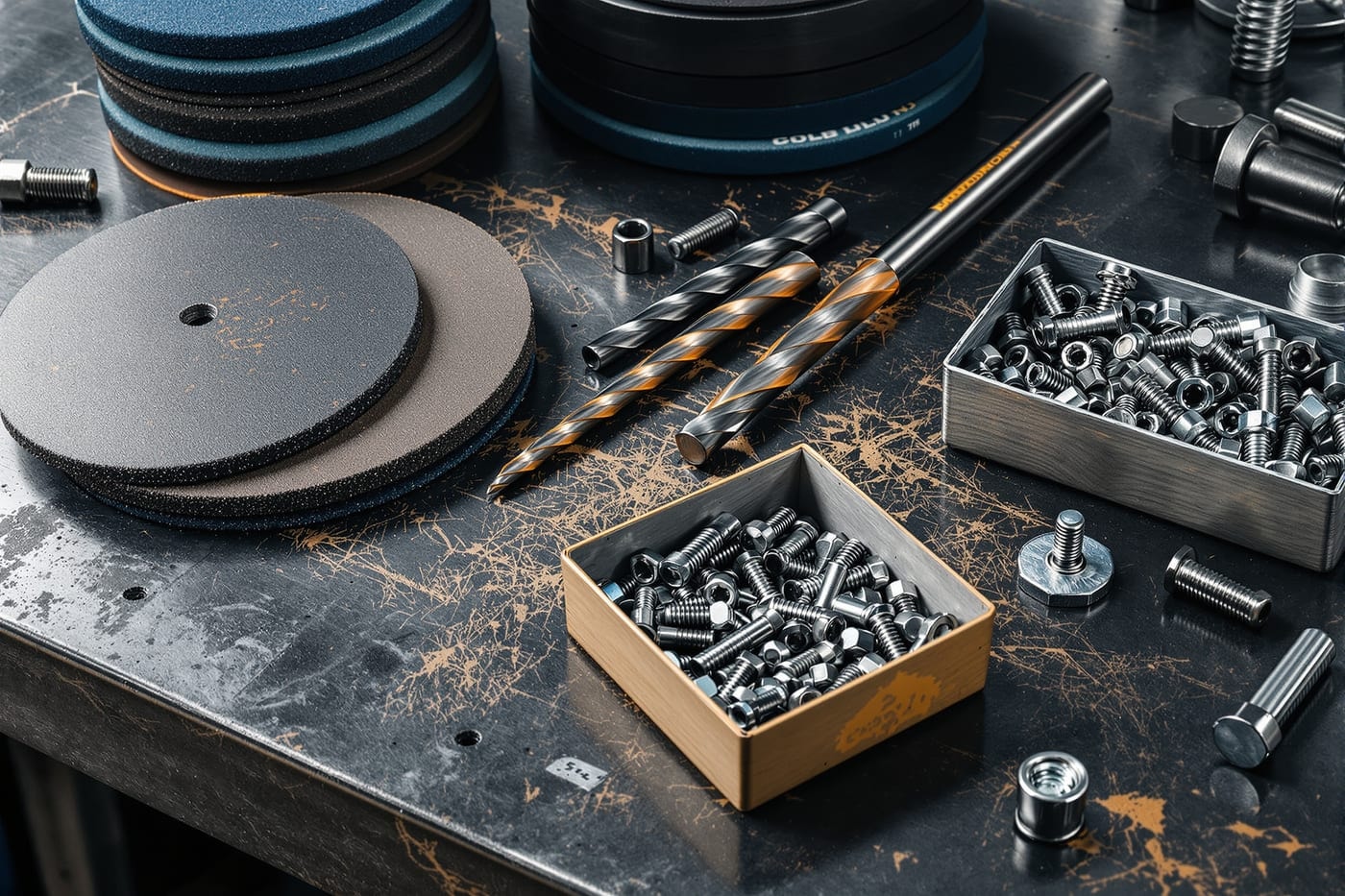
Forty-nine lines were filed under Tools. Despite the name, very little of it was powered equipment. This was the consumables heading — the fasteners, drills, abrasives and welding materials that a workshop gets through continuously and that stop a job dead when the store runs out.
What the line covered
The catalogue listing shows five clear groups.
Fasteners
Allen cap screws and Allen countersunk screws, hex bolts in stainless steel 304, eye bolts and eye nuts, foundation bolts, high-tensile steel coupling bolts, anchor fasteners and bullet fastener grub screws. Between them these cover the four ways things get fixed in a plant: bolted joints in machinery, cast-in or drilled-in anchorage into concrete, lifting points, and grub-screw location on shafts.
The presence of both stainless 304 hex bolts and high-tensile coupling bolts in the same short list is informative. Stainless is chosen for corrosion resistance and is comparatively weak; high-tensile is chosen for load and corrodes readily. A supplier carrying both is serving customers who understand that the two are not interchangeable, whatever the head marking suggests.
Drilling and cutting
Carbide and HSS tooling drills, gear hob cutters, and resin-bonded cutting and grinding wheels from more than one manufacturer. Carbide holds an edge at higher speeds and in harder material but is brittle; high-speed steel tolerates interrupted cuts and misuse. Both were stocked because a maintenance fitter drilling an unknown weldment and a production machinist cutting a known alloy want opposite things from a drill.
Abrasives
Cutting and grinding wheels appeared as several parallel lines. Bonded abrasive wheels are among the most hazardous consumables in general workshop use — they store rotational energy, they degrade in storage, and they fail catastrophically when over-speeded, side-loaded or mounted against a damaged flange. Wheel speed marking, mounting and guarding requirements are set out in the abrasive-wheel provisions of the OSHA machine guarding standards.
Welding
ARC and gas welding materials were carried under this heading and cross-tagged into Electric, which is the correct place for the transformer and cable side of the job. Consumables in this group are the electrodes, filler and gas-side fittings that a fabrication shop treats as stock rather than as equipment.
Tapes and general
Brown packing tape and double-sided tape appeared here as well as under Gift and Packaging, and bridge bearing pads — elastomeric pads that carry load and accommodate movement between structural members — sat at the heavier end of the same heading.
Cross-tagged items
A third of this line was also classified in another product group. Allen caps, Allen countersunk screws, anchor fasteners and carbide drills were also filed under Aluminium, which in this catalogue was the fabrication-hardware heading rather than a metals line. Nylon rope and pulleys were shared with Pulling Support. Cutting and grinding wheels were shared with Others.
How the line was specified
Almost nothing in this heading was sold on brand. A buyer ordering hex bolts specifies material grade, thread form, length and finish; a buyer ordering cutting wheels specifies diameter, thickness, bore and maximum operating speed. Those parameters come from published standards, not from catalogues — fastener mechanical properties and test methods are covered by ASTM International, and the corresponding Indian specifications are maintained by the Bureau of Indian Standards.
This is why the catalogue could carry several apparently identical entries under one name. They were different grades or different sources of the same functional item, and a customer standardised on one of them needed it to stay available.
Storage and shelf life
Two groups in this line degrade in the store rather than in service. Bonded abrasive wheels absorb moisture and should be kept dry, flat and away from impact; a wheel that has been dropped is scrap regardless of how it looks. Welding electrodes with basic coatings pick up moisture from the air and need controlled storage if the weld metal is to meet its rated properties. A store that treats both as ordinary shelf stock will eventually produce a failure that gets blamed on the operator.
Related lines: Safety for the eye, hearing and hand protection that abrasive and welding work require, and Aluminium for the ladders and access equipment that go with fixing work at height.