Aluminium
The access-equipment and fabrication-hardware heading — ladders, sample bottles, anchors and fixings.
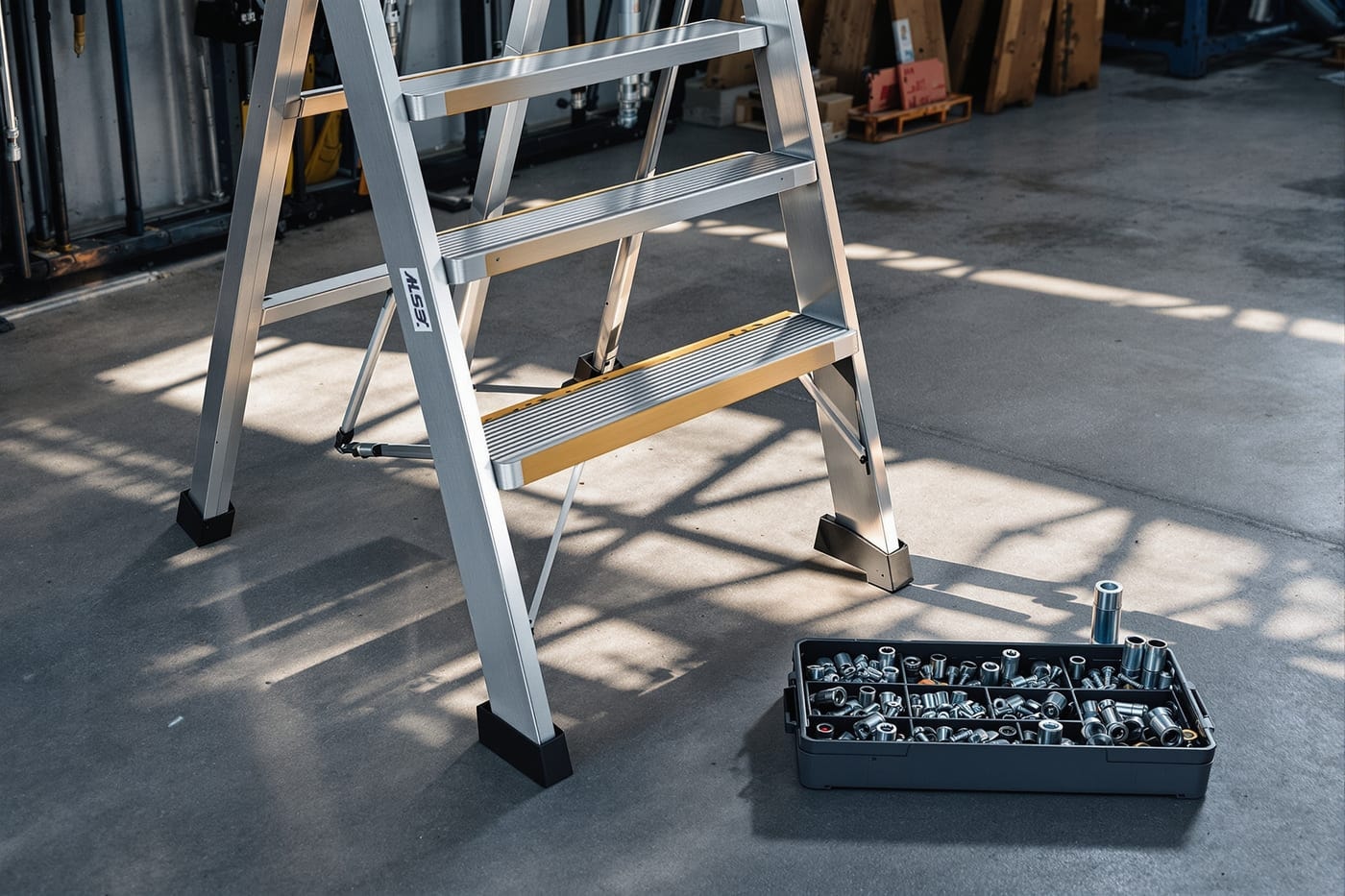
Sixty-nine lines made Aluminium the largest single heading in the catalogue. The name is misleading if you read it as a metals line. In practice this was the access-equipment and fabrication-hardware heading, and a large share of its contents were steel.
Access equipment
Aluminium folding ladders appeared as four separate lines. Four near-identical entries under one name is a signal about the customer base rather than a listing error: a supplier carries several heights and duty ratings of the same ladder because the buyer is choosing between them on reach and load, and because a site standardised on one of them needs it to remain available.
Aluminium is the normal material for portable industrial access because it is light enough to be moved by one person and does not corrode in the way a painted steel ladder does. Its disadvantage is decisive in one context: it conducts. A metal ladder must not be used near live electrical equipment, which is where fibreglass equipment and the dielectric harnesses and insulating matting in the safety line take over. Ladder construction, selection and use requirements are set out in the OSHA ladders standard.
Sample bottles
Aluminium sample bottles were carried as two lines. These are the containers used to take and transport samples of oil, fuel, solvent or process fluid for laboratory analysis. Aluminium is chosen over glass for transport robustness and over plastic where the sample would attack, absorb into or be contaminated by a polymer container. Their presence indicates customers running condition-monitoring programmes — routine oil sampling on gearboxes and hydraulic systems, which is the same customer buying the gear and hydraulic oils further along the catalogue.
Fabrication hardware
The bulk of the line is fixing hardware, most of it cross-tagged into Tools: Allen cap screws, Allen countersunk screws, anchor fasteners, bullet screws, carbide and HSS tooling drills, brass pipe fittings, D-shackles and auto/manual pulleys.
The pattern here is that the catalogue filed an item under Aluminium when it was part of building or modifying something, and under Tools when it was part of consuming or cutting something. An anchor fastener is both — it is a drilled-in fixing, so it appears under both headings.
Anchor fasteners
Anchor fasteners are the interface between machinery and structure. A pump baseplate, a mezzanine leg, a cable tray bracket and a machine guard are all held to concrete by anchors, and the failure mode when they are wrong is not gradual. Anchor selection depends on the base material, the edge distance, the embedment depth and whether the load is static or vibrating — which is why a supplier stocks several types rather than one.
Flameproof junction boxes
Flameproof junction boxes appear under Aluminium as well as under Safety and Electric, and the cross-tagging is technically correct. These enclosures are cast in aluminium alloy or in iron precisely because the protection depends on the mechanical strength of the casting and the accuracy of its machined joint faces. The casting is the safety device.
Working with aluminium
Two practical points sit behind this heading and are worth recording, because they are the reasons an aluminium line and a stainless line do not substitute for each other.
Galvanic pairing. Aluminium in direct contact with stainless steel or brass in the presence of moisture corrodes preferentially, and the aluminium is always the part that goes. This is why stainless fasteners into aluminium sections are isolated or coated on outdoor and washdown installations.
Thread strength. Aluminium threads strip at a fraction of the torque a steel thread takes. Tapped aluminium is usually fitted with a thread insert where the joint will be broken repeatedly — a detail that matters on access equipment and enclosures more than anywhere else in this catalogue.
Material designations and mechanical property standards for aluminium alloys and for fasteners are published by ASTM International.
Related: Pulling Support for the shackles and pulleys shared with this line, and Tools for the drills and screws.