Pipes & Pipes Fitting
Valves, fittings, hoses, gaskets and gland packing, across twenty reducing size combinations.
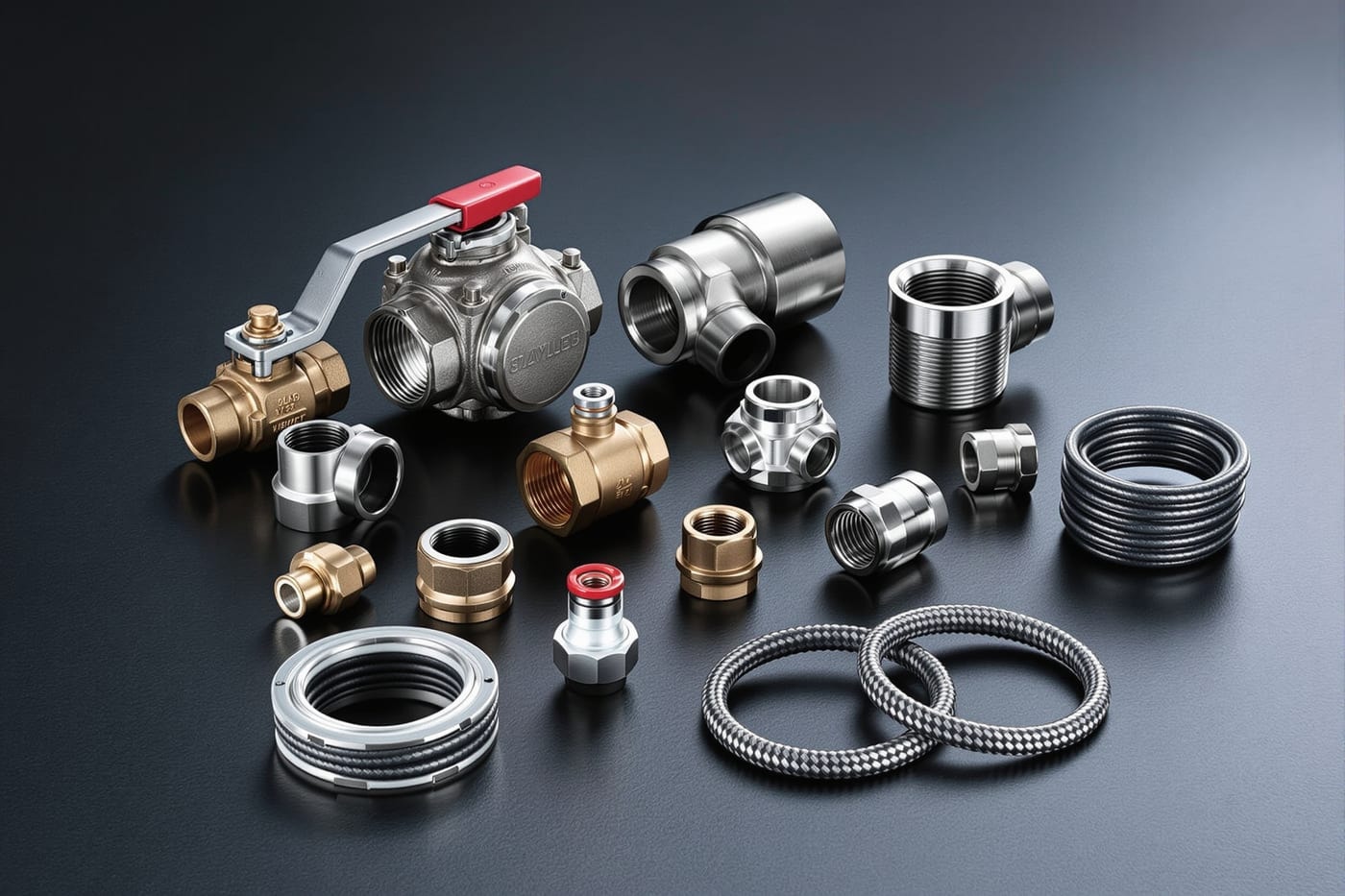
Forty-eight lines were filed under Pipes & Pipes Fitting, with a published size facet covering twenty reducing combinations. It was the most technically specified heading in the catalogue and the one where the customer almost always knew exactly what they wanted before they started looking.
Valves
The valve range was chosen by function rather than by manufacturer, and it covers the four jobs a plant valve does.
- Ball valves — in brass, in plastic and in CPVC. A quarter-turn isolating valve: full bore, low pressure drop, quick to operate, and intended to be either open or shut rather than throttled.
- Butterfly valves — the large-diameter isolating choice, where a ball valve becomes impractically heavy and expensive. Compact face-to-face, and usable for coarse throttling.
- Check valves — non-return protection, listed in the catalogue under the common trade spelling. These keep a pump from being driven backwards and stop a system draining through a stopped pump.
- Float valves — automatic level control on tanks, mechanical and self-contained.
- Brass valves and stop cocks — the small-bore isolation used on services and instrument lines.
The CPVC entries are worth noting. Chlorinated PVC handles hot water and many chemical duties where plain PVC will not, and it is chosen deliberately where metal would corrode. A supplier stocking brass, plastic and CPVC ball valves in parallel is serving general services, chemical services and hot water from the same shelf.
Fittings
Elbows, flanges, forged fittings, flare fittings, hydraulic flare fittings, ferrule fittings, brass pipe fittings, bush couplings, grooved-end stainless couplings and boiler nozzles. Between them these represent every common way of joining a pipe: welded, flanged, threaded, compression-ferruled, flared and grooved-clamp.
The grooved coupling deserves a mention because it changes how a plant is maintained. A grooved joint can be broken and remade by two people with a spanner in minutes, without hot work and without a welding permit — which on a live site is often the deciding factor rather than cost.
The size range
The published size facet lists reducing combinations 20×15, 25×15, 25×20, 32×15, 32×20, 32×25, 40×15, 40×20, 40×25, 40×32, 50×15, 50×20, 50×25, 50×32, 50×40, 65×50, 80×50, 80×65, 100×50 and 100×65.
Every one of those is a reducer. Nothing in the list is a straight size-to-size fitting, which tells you what the stock was for: joining pipe runs of different generations to each other. A plant extended three times has three pipe sizes in it, and the fittings that are never available locally are precisely the transitions between them.
Hoses and flexible connections
Air hose appeared twice, cross-tagged into Aluminium for the coupling hardware, along with flexible precision-made pipe. Flexible connections do two jobs in a plant: they absorb vibration so that a pump or compressor does not fatigue its own pipework, and they accommodate thermal movement on hot lines. They are also a wear item, and a flexible section that has gone hard has stopped doing either job while still looking serviceable.
Sealing
Gasket sheet, gland packing and graphitized gland packing were carried here and cross-tagged into Safety.
Gland packing is the braided material compressed into the stuffing box around a rotating shaft — a pump or valve stem — to seal it. Graphitized packing is used where temperature or shaft speed would burn out a plain fibre packing, and it also conducts heat away from the shaft rather than trapping it. It is one of the highest-turnover items in any maintenance store, because packing is designed to be consumed: correctly adjusted, it leaks slightly by design, and it is repacked on a schedule rather than on failure.
Specification, not brand
Nothing here is bought by name. A valve is specified by size, body and trim material, pressure class, end connection and operator; a flange by size, class, face type and drilling. Those dimensional and pressure-class standards are maintained by ASME, with the corresponding Indian specifications published by the Bureau of Indian Standards. Any item on this page can be re-sourced today by quoting those parameters to another distributor.
Related: Oil for hydraulic and silicone fluids, and Others for the rubber sections, EPDM and bushes used alongside these fittings.