Pulling Support
Chain pulley blocks, shackles, pulleys and rope — where the catalogue moves from consumables into rated equipment.
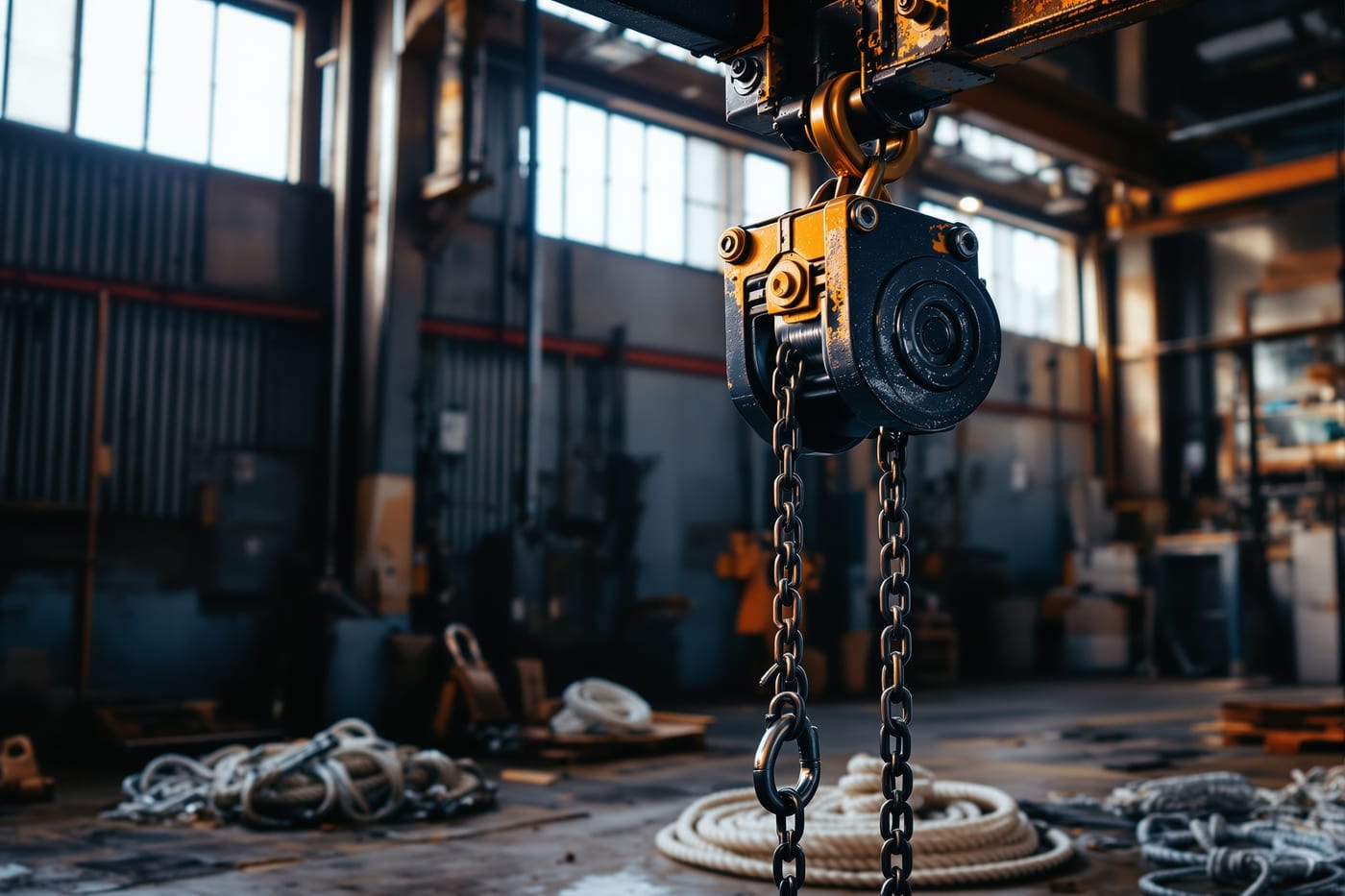
Fifteen lines covered the lifting and pulling equipment: chain pulley blocks, auto and manual pulleys, D-shackles, nylon and plastic rope, spurs, couplings, expanded graphite products and the timing and lifting belts shared with Machinery Belts. It is the heading where the catalogue moves from consumables into rated equipment, and the distinction matters more here than anywhere else in the range.
Chain pulley blocks
Two chain pulley block entries were carried. A chain block is a hand-operated hoist: a load chain running over a geared sheave, driven by a hand chain, giving a mechanical advantage large enough for one person to lift several tonnes and — critically — holding the load automatically when the hand chain is released.
It is the tool that makes maintenance possible in places a crane cannot reach. A pump is lifted off its baseplate, a motor is drawn off a shaft and a valve is held while a flange is broken, all with a chain block hung from a beam clamp or a trolley. That is also why it is often the only lifting appliance on a small site, and why its condition matters: the load brake is the part that stops the load coming back down, and it is not something an operator can inspect from the floor.
Rated lifting appliances need periodic thorough examination, with a record kept, rather than the visual check applied to consumables. Inspection, marking and safe-use requirements for slings and the fittings used with them are set out in the OSHA slings standard.
Shackles
D-shackles are the universal connector between a lifting point and a sling. They are simple and they are the component most often used wrongly. Three points cover most of it: the working load limit is stamped on the body and is not a guess; a shackle must be loaded along its axis rather than side-loaded, which sharply reduces its capacity; and the pin must be the pin that came with it, because a bolt of the same diameter is not the same steel and will fail well below the marked rating.
Pulleys
Pulleys appeared as several entries — plain pulleys, auto and manual pulleys — cross-tagged into Tools, Others and Aluminium. In this line a pulley is a rigging component: a sheave in a block used to change the direction of a pull or to gain mechanical advantage in a multi-part reeving. In the Others line the same word describes a drive pulley for a belt, which is an entirely different item. The catalogue's cross-tagging reflects the ambiguity honestly rather than resolving it.
Rope
Nylon rope and plastic rope were carried, cross-tagged into Tools and Packaging respectively, and the distinction between them is the useful part.
Nylon is strong, abrasion-resistant and elastic. That elasticity is an advantage when a shock load has to be absorbed and a serious hazard when a rope under tension parts — a stretched nylon rope stores a great deal of energy and releases it along the line of pull. Nylon also loses a meaningful fraction of its strength when wet.
Polypropylene and polyethylene ropes — the plastic rope of the catalogue — are lighter, float, resist chemicals and cost far less, but they are weaker, they abrade and they degrade under prolonged ultraviolet exposure. They are lashing and general-purpose rope, not lifting rope.
Neither is rated lifting equipment unless it is supplied and marked as such. Rope that has spent a season outdoors should be treated as unknown regardless of appearance.
Spurs, couplings and graphite
Spurs and couplings sit at the boundary between this heading and the drive-train items in Others, and expanded graphite products appear here as they do in Safety — graphite is used both as a high-temperature sealing material and as a dry lubricant on chain and screw mechanisms where oil would collect dust.
The rule that separates this heading from the rest
Everything else in this catalogue fails quietly. A gasket weeps, a belt squeals, a wheel wears down. Lifting equipment fails instantly, with a load above it. That is why chain blocks, shackles and slings carry marked ratings, why they are examined on a schedule rather than on symptoms, and why a damaged item is destroyed rather than set aside — an unmarked or unrated component put into a lifting assembly is the single most common way a rated system stops being rated.
Related: Machinery Belts for the lifting and timing belts shared with this line.