Electric
Switchgear and control panel accessories, instruments, cable and glands, and industrial lighting.
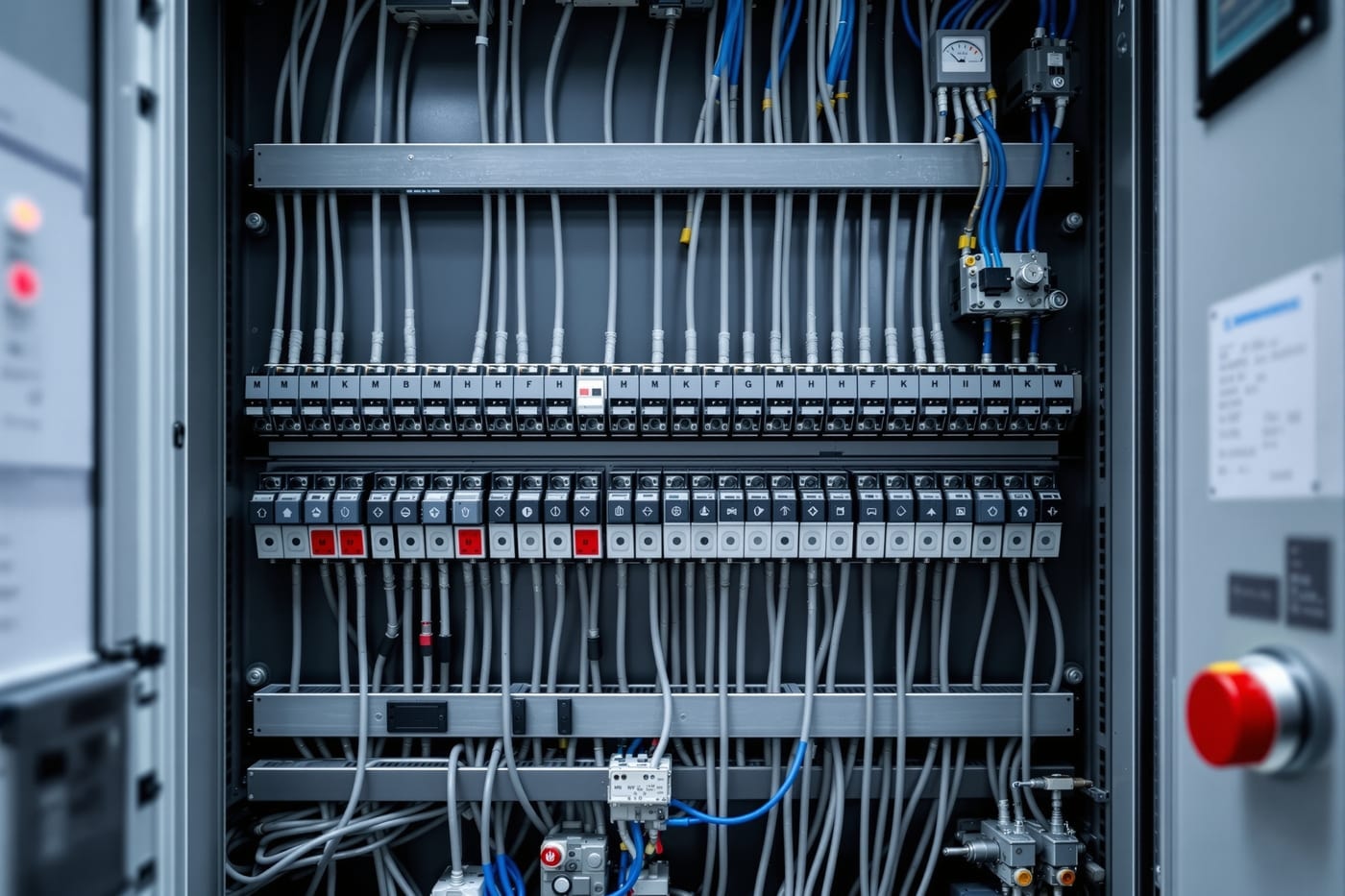
The Electric heading was the widest in the catalogue and the one that spanned the largest range of value, from a fuse to a high-mast solar lighting installation. The industrial half of it — switchgear, instruments, cable and lighting — is described here. The heading also accumulated a large volume of branded consumer appliance stock, which was outside the industrial range described here.
Switchgear and control panel
Control panel accessories and MCBs, contactors, DOL starters, emergency stop buttons, fuses and connectors made up the switching and protection line. Together these are the contents of a standard motor control panel.
MCBs — miniature circuit breakers — protect the cable, not the load. They are selected on the cable's current-carrying capacity and on a tripping characteristic matched to the inrush of whatever is downstream, which is why a breaker that nuisance-trips on a motor start is usually the wrong curve rather than the wrong rating.
Contactors are the electrically operated switches that actually start and stop a motor. They are wear items: the contacts erode with every switching operation, and a contactor on a frequently cycled load has a life measured in operations rather than in years.
Direct-on-line starters are the simplest motor starter — full voltage applied at once, drawing a starting current several times the running current. They are cheap and robust, and they are limited by that inrush, which is why larger machines move to reduced-voltage or electronic starting.
Emergency stop buttons are a safety function rather than a control: latching, manually released, and wired so that the stop is achieved by de-energising rather than by asking a controller to act. Their placement is fixed by risk assessment, and a machine that has been extended without moving its stops has a real gap in its protection.
Instruments
Ammeters and clamp meters were carried as separate lines. A panel ammeter is a permanent installation that lets an operator see load at a glance and spot a rising trend before it becomes a fault. A clamp meter is the portable equivalent, and its virtue is that it measures current without breaking the circuit — the reason it is the first instrument any maintenance electrician reaches for.
Cable, glands and earthing
Industrial cable, armoured cable for CCTV, DC glands and earthing material for high-tension work were the distribution side of the line, with earthing material cross-tagged into Safety.
Armoured cable is used wherever mechanical damage is likely — buried runs, cable pulled through structure, anywhere a vehicle or a dropped tool could reach it. The armour is also a protective conductor, which is why the gland matters as much as the cable: a gland is what bonds the armour to the enclosure and maintains the enclosure's ingress rating at the same time. A cable entering a box through an unglanded hole has lost both functions at once.
Earthing material is the least visible part of an installation and the part everything else depends on. Protective devices only operate because fault current has a low-impedance path back to source; where that path is degraded, a fault does not clear, it persists at a level that is dangerous and invisible.
Industrial lighting
Flood lights, FLP sunflower lights, high bay fittings, industrial flameproof lighting and high-mast solar lighting made up the lighting line, alongside industrial exhaust fans, cooling fans and excel fans.
High bay fittings are the lamps used at height over a factory floor, where the design problem is delivering usable light at floor level from ten metres up without glare, and where relamping means bringing access equipment into a working area. Flameproof and FLP fittings are the versions built for atmospheres where an ignition source cannot be permitted; they follow the same containment principle as the flameproof junction boxes described under Safety. The international framework for equipment in explosive atmospheres is published by the IEC, and installation practice generally follows national wiring rules such as those maintained by the National Fire Protection Association.
Welding supply
ARC and gas welding materials were cross-tagged here from Tools. The split is sensible: the consumables belong with tooling, and the supply, cabling and connection side belongs with the electrical line.
Related: Safety for insulating matting, dielectric harnesses and flameproof enclosures.