Safety Equipment
Personal protective equipment, electrical safety materials, flameproof enclosures, sealing and heat insulation.
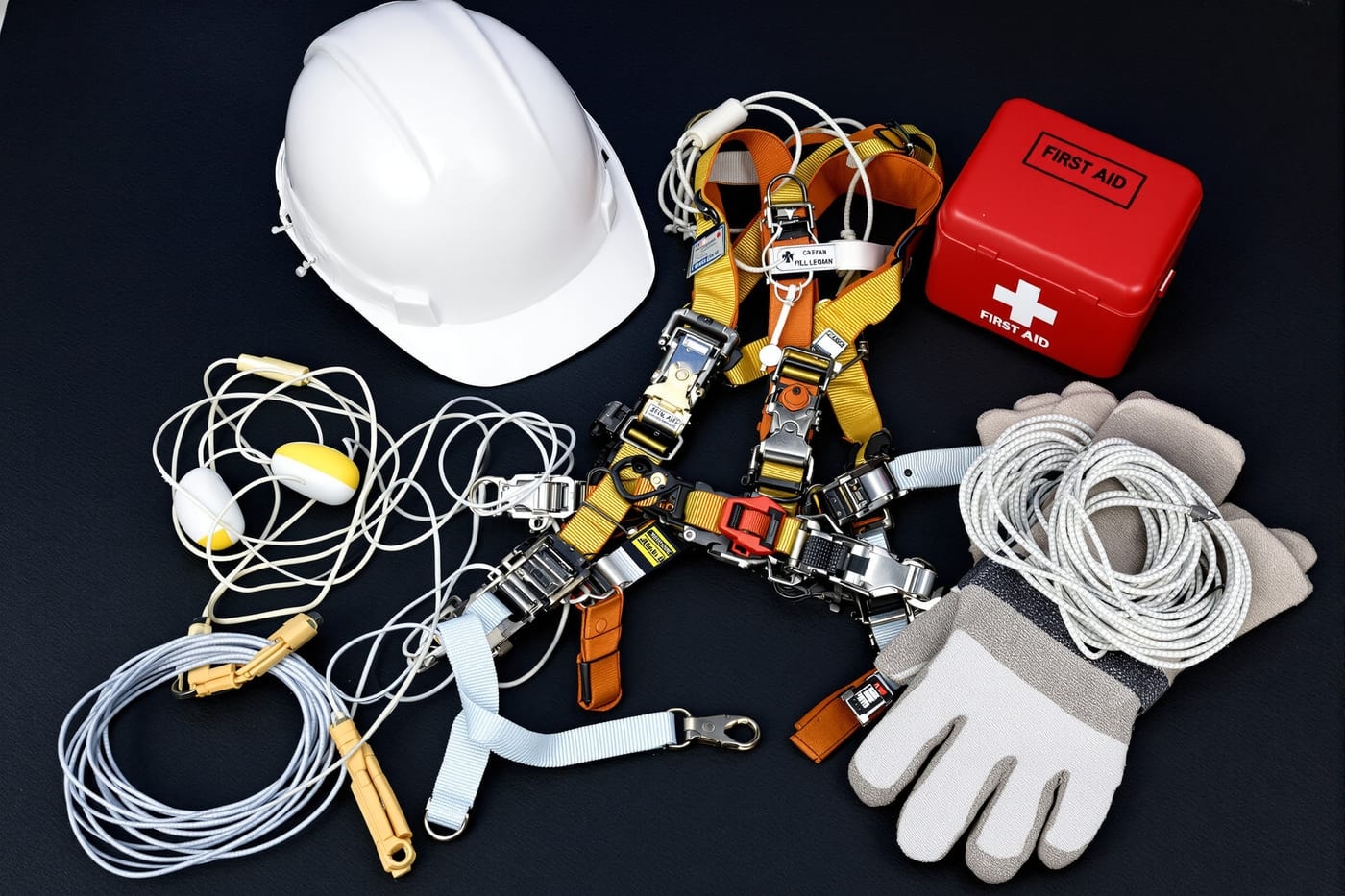
Twenty-three lines were filed under Safety, with a published thickness facet running from 1 mm to 10 mm. It was one of the two businesses the company named in its own description of itself, and it was structured around hazards rather than around product families — which is why gasket material, rope and junction boxes share a heading with helmets and ear plugs.
Personal protective equipment
The wearable side of the line covered helmets, corded ear plugs, dielectric non-conductive safety harnesses, and first aid boxes and pouches. It is a short list, and the choices in it are pointed.
Corded ear plugs rather than plain plugs. The cord is what makes them survivable in a plant: it keeps the pair together, it makes removal visible to a supervisor, and it stops a plug being set down on a contaminated surface and put back in.
Dielectric non-conductive harnesses. A standard fall-arrest harness carries steel D-rings and metal buckles, which is a serious problem near live equipment. A dielectric harness substitutes non-conductive hardware so that a worker at height near an energised conductor is not wearing a bonding path. It is a specialist item, and its presence in a twenty-three-line range says the customer base included electrical maintenance work at height.
First aid boxes and pouches in two formats — the fixed box for a workplace and the pouch for a vehicle or a crew working away from it.
Selection of protective equipment is meant to follow an assessment of the specific hazard, not a general shopping list; the hazard-based framework is set out by the Occupational Safety and Health Administration, and equipment performance research is published by the National Institute for Occupational Safety and Health.
Electrical safety materials
Electrical rubber matting and earthing material were carried here and cross-tagged into Electric. Insulating matting is laid in front of switchgear so that an operator working on a panel is standing on a rated insulating surface rather than on a conductive floor. It is rated by thickness and by proof voltage, which is exactly what the 1 mm to 10 mm facet on this category is describing, and it is a consumable — matting is damaged by oil, by dragged equipment and by ordinary wear, and it stops being protective long before it looks worn out.
Flameproof enclosures
Flameproof junction boxes appeared under Safety and again under Electric and Aluminium. The catalogue described the item directly:
A flameproof junction box is an electrical enclosure designed to contain electrical connections and protect them from the surrounding environment, particularly in hazardous or potentially explosive locations.
That description is worth reading carefully, because it is more accurate than most. A flameproof enclosure does not keep a flammable atmosphere out. It accepts that gas will enter, and is built so that if the mixture inside ignites, the explosion is contained and the flame path out of the joint faces is long and narrow enough to cool the escaping gases below the ignition temperature of the atmosphere outside. That is why the joint surfaces matter so much, why a missing bolt or a painted flange face defeats the protection, and why these enclosures are heavy castings rather than sheet boxes. The international framework for equipment in explosive atmospheres is published by the IEC.
Sealing and gasket materials
Cut gaskets, expanded graphite cut gaskets in metallic and non-metallic forms, and gasket sheet were filed under Safety rather than under fluid handling. That placement is not arbitrary: a failed gasket on a hot or hazardous line is a personnel hazard first and a process problem second. Expanded graphite is the material of choice for high-temperature steam and process duty because it does not creep or relax the way compressed fibre does; the metallic-reinforced versions add the crush resistance needed on wider flange faces.
Heat insulation
The largest single group in this line is thermal protection: ceramic rope, fibreglass rope, heat-insulating tape, heat-insulating fibre sleeve, heat-insulating blanket and glasswool sheet. These are the materials that go around a hot line, an oven door, a mould or a welding zone. Ceramic rope handles the highest temperatures and is used for sealing furnace and oven doors; fibreglass rope and sleeving protect hoses and cables running near hot work; blanket and glasswool are the bulk insulation. Bubble roll also appeared under this heading, cross-tagged from Packaging, where it is used as a protective wrap rather than as insulation.
Why this line and the tools line belong together
Every hazard covered here is created by something in another category. Abrasive wheels and drilling create the eye and hearing hazards; work at height on ladders creates the harness requirement; switchgear work creates the dielectric and matting requirement; hot work creates the insulation requirement. A supplier that sells the hazard and not the protection is only doing half the job, which is the reasoning behind the two-business description the company gave of itself on its about page.